Who we are
About
About our Association
Who we are
The Association of Indigenous Cabildos of the Municipality of Villagarzón Putumayo, identified by the acronym ACIMVIP and with NIT 846.004.150-4, is a special public-law entity with legal personality, its own assets, and administrative autonomy, governed by Decree 1088 of 1993. The current Bylaws describe it as a non-profit Indigenous entity that exercises organizational and political representation, in self-government, of the Inga People of Villagarzón, Putumayo. Its principal domicile is the municipal seat of Villagarzón, in the Las Villas neighborhood.
It operates in the municipality of Villagarzón and, in accordance with the 2023 Bylaws, in the traditional ancestral territories of the Indigenous Peoples and in those recognized through settlement dynamics within that jurisdiction. The territory of the Inga People of Villagarzón extends across the Middle Putumayo, in the municipalities of Villagarzón, Mocoa, and Puerto Guzmán.
Origin, establishment and registration
ACIMVIP was born as an initiative of the Inga People on March 26, 1998, to work for collective and individual rights, respect for nature, and the cultural, social, economic, productive, and political strengthening of the Indigenous communities of Villagarzón, guided by the principles of unity, territory, culture, and autonomy. It was formally constituted at the general assembly held on June 12 and 13, 2004, in Villagarzón, where the bylaws were approved and the Executive Committee was appointed. The Directorate of Ethnic Affairs of the Ministry of the Interior and of Justice registered that constitution through Resolution 0033 of July 22, 2004; the act records the participation of communities of the Inga and Nasa Peoples.
Resolution 0099 of August 17, 2007, registered the affiliation of the Blasiaku Reservation and of the cabildos Musu Waira Sacha Nucanchipa and Saladilloiaco. The ICBF Putumayo Regional Office recognized the legal personality of the Association through Resolution 390 of July 30, 2021. On April 1, 2024, the Directorate of Indigenous, Rom, and Minority Affairs of the Ministry of the Interior registered, through Resolution 087, the Board of Directors and the amendment to the bylaws, and on May 3, 2024, the ICBF Putumayo Regional Office, through Resolution 156, registered the legal representative and approved the bylaws of December 22, 2023.
Bylaws, corporate purpose and principles
The Bylaws were approved by the Assembly of Governors and have been in force since February 14, 2016. On December 22, 2023, the general assembly reviewed and approved their amendment, promulgated that day and registered and approved by the 2024 resolutions cited above. The purpose of the Association is to promote, support, and safeguard the comprehensive development of the affiliated Indigenous communities: to design, formulate, implement, and monitor the life plan of the Inga People of Villagarzón, strengthen their own forms of organization, agree on and coordinate actions with national and international entities, demand compliance with prior consultation, and facilitate guarantees for the victims of the armed conflict, among other objectives.
It is governed by the principles of unity, solidarity, autonomy, respect for one's word, territoriality and Mother Earth, community work, identity, interculturality, respect for human rights, equity, equality, and suitability, and by the Inga principles Ama Killai (do not be lazy), Ama Sisaii (do not steal), Ama Llullaii (do not lie), and Suma Iuiai (think well). In exercise of the special Indigenous jurisdiction (Article 246 of the Political Constitution), it acts as a judge of instance in conflicts arising within the communities, upon request or on its own initiative when the Assembly deems it appropriate.
Associated Cabildos (Indigenous traditional authority) and Reservations
ACIMVIP brings together 13 Indigenous authorities of the Inga People of Villagarzón, representing 12 communities. Seven communities have their own reservation: the Inga Indigenous Reservations of Albania, Blasiaku, Calenturas, Chaluayaco, Saladilloiaco, San Miguel de la Castellana, and Wasipungo. Four cabildos share the Inga Indigenous Reservation of Nukanchipa Alpa Amukunapa Wasi: the Cabildo Alparumiyaco Alto San Juan Las Delicias, belonging to the Inga Indigenous Reservation of Nukanchipa Alpa Amukunapa Wasi, the Cabildo Cachiacu Andaki, belonging to the Inga Indigenous Reservation of Nukanchipa Alpa Amukunapa Wasi, the Cabildo Nukanchipa Taita Kausadiru, belonging to the Inga Indigenous Reservation of Nukanchipa Alpa Amukunapa Wasi, and the Cabildo Musu Waira Sacha Nucanchipa, belonging to the Inga Indigenous Reservation of Nukanchipa Alpa Amukunapa Wasi, each belonging to the Inga Indigenous Reservation of Nukanchipa Alpa Amukunapa Wasi. One community, the Cabildo Indígena Atun Taita Ambi Upiadiru, has its own cabildo and is moving toward the constitution of its reservation. The thirteenth authority is the Cabildo of the Nukanchipa Reservation.
The reservations were constituted through the acts listed in Annex A: Calenturas in 1989, Wasipungo and Albania in 1999, Chaluayaco in 2000, San Miguel de la Castellana in 2002, Blasiaku in 2004, Nukanchipa Alpa Amukunapa Wasi in 2020, and Saladilloiaco in 2025.
How the Association is governed
The Bylaws establish an Assembly of Governors, an Executive Committee, and a Control Council, also called the Council of Elders; the 2023 Bylaws further distinguish the Fiscal and reserve to the Executive Committee the status of administrative body.
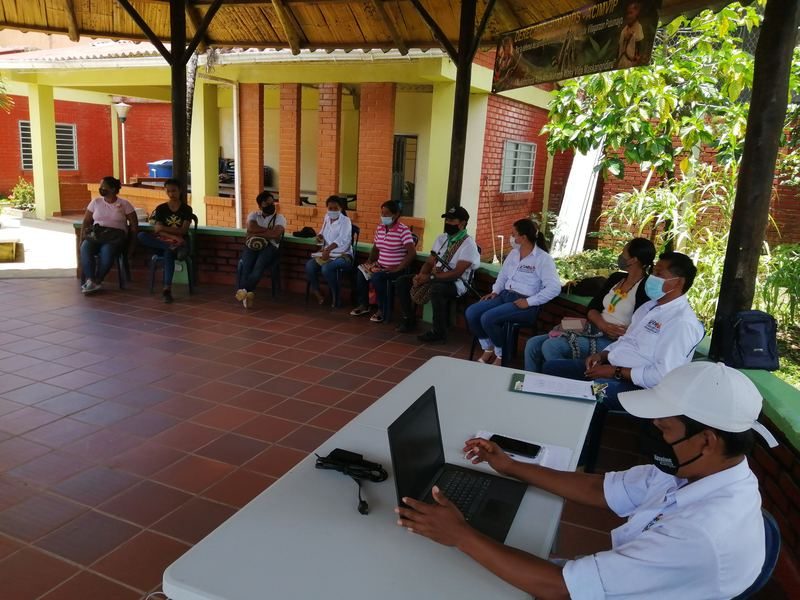
The General Assembly of Governors is the highest authority of the Association and is made up of the governors of the member cabildos, one per cabildo. It deliberates and decides with half plus one of its members, whose attendance is certified by the Fiscal, which with 13 authorities amounts to 7; amending the Bylaws, dissolving the Association, and changing the board require two thirds, that is, 9 of 13. It meets in ordinary session four times a year, quarterly, and in extraordinary session when convened by the President, the Fiscal, or one quarter of the governors, with notice of no less than eight days. It approves and amends the Bylaws, elects and removes the members of the Executive Committee and the Council of Elders, sets dues, approves reports, balance sheets, and plans, defines the organizational structure, and creates the coordinations needed to implement the life plan.
The Executive Committee is the highest administrative body and is made up of four positions: the Presidency, the Vice Presidency, the General Secretariat, and the Treasury. It resolves and directs the affairs of the Association while the Assembly is not in session, executes the budget programmed with the governors, and approves loans with prior authorization from the Assembly. The Presidency holds legal representation, chairs the Assembly and the Committee, convenes meetings, and signs checks and other negotiable instruments together with the Treasury; the Vice Presidency replaces it in its absence; the General Secretariat keeps the minutes and the archive and signs the notices of meeting; and the Treasury keeps the accounting books and presents the balance sheet as of December 31.
The Council of Elders is the oversight body for the management of the Executive Committee. It is made up of five members elected by the Assembly, who periodically review the treasury accounts, respond to the Committee's inquiries, and issue opinions before the Assembly to resolve conflicts among the member communities. From among its members comes the Fiscal, who oversees the Committee's management acts, certifies the Assembly's quorum, issues opinions on the reports of the Presidency and the Treasury, and signs the financial reports; under the 2023 Bylaws, the Fiscal is not part of the Executive Committee and is elected by the Assembly.
To put the life plan into practice, the Assembly creates thematic coordinations. The 2023 Bylaws list ten: Territory and Environment; Self-Government and Indigenous Justice; Economy and Production; Indigenous Education; Indigenous Health; Human Rights; Planning, Infrastructure, and Basic Sanitation; Culture and Sports; Political Participation; and Women and Family. The Executive Committee attends to the reports they issue.
Other bodies of the self-government of the Inga People of Villagarzón operate alongside the Association without being its organs: the Minga of Territorial Thought, the highest authority of the Ancestral Territory; the Assembly of Authorities of the Nukanchipa Reservation; the Mingas of Thought of each community; and the Higher Council for the Administration of Indigenous Justice, the second instance of Indigenous justice, which must not be confused with the Association's Council of Elders.
Current legal representation
The legal representation of the Association is exercised by the holder of the Presidency of the Executive Committee. It was registered by the Ministry of the Interior through Resolution 087 of April 1, 2024, for the period from January 1, 2024, to December 31, 2027, and took office on January 10, 2024.
ACIMVIP Organizational Chart
Tap each body to see what it is and its source. Positions only; no personal names.
Associated Cabildos and Reservations (13 authorities)
What it is: The associated Indigenous authorities: the governor of each Cabildo. They elect the bodies of the Association through the Assembly.
Members: 13 governors: 7 with their own Reservation, 4 from the Nukanchipa Reservation, Atun Taita and the Cabildo of the Nukanchipa Reservation
Source: Bylaws 2023, art. 8 (DOC-14270 p. 5; DOC-13095 p. 5); art. 10 (DOC-14270 p. 6; DOC-13095 p. 6)
General Assembly of Governors
What it is: Highest authority of the Association. Approves and amends the Bylaws, elects and removes the Executive Committee, the Council of Elders and Oversight and the Fiscal, approves reports, balance sheets and plans, sets dues, defines the structure and creates the Coordinations.
Members: The governor of each associated Cabildo, one per Cabildo (13). The Executive Committee and the Council of Elders attend to submit reports, without a vote. To amend the Bylaws, each member is represented by the governor, a former governor and two board members, but the governor decides with voice and vote.
How it decides: Half plus one (7 of 13) for ordinary matters. Two thirds (9 of 13, derived) to amend the Bylaws, dissolve the Association, change the board and elect the Executive Committee; the proposal must be submitted eight business days in advance (2016, art. 24 para.).
Meets: Ordinary four times a year, quarterly (2023, art. 17); six times in 2016 (art. 14). Extraordinary if convened by the President, the Fiscal or one fourth of the governors; written or telephone notice no less than eight days in advance and, if extraordinary, with an agenda.
Source: Bylaws 2023, art. 13 (DOC-14270 p. 8; DOC-13095 p. 8); art. 15 (DOC-14270 p. 8; DOC-13095 p. 8); art. 16 (DOC-14270 p. 8; DOC-13095 p. 8); art. 17 (DOC-14270 p. 9; DOC-13095 p. 9); art. 41 (DOC-14270 p. 20; DOC-13095 p. 22); art. 42 (DOC-14270 p. 20; DOC-13095 p. 22); art. 66 (DOC-14270 p. 27; DOC-13095 p. 29)
Executive Committee
What it is: Highest administrative body. Resolves and directs the affairs of the Association while the Assembly is not in session, executes the budget programmed with the governors, approves loans with prior authorization of the Assembly, formulates the action plan and attends to the reports of the Coordinations.
Members: Four positions: Presidency (legal representation), Vice Presidency, General Secretariat and Treasury. Requirement: endorsement minutes from the community and membership in an affiliated Cabildo.
Meets: Meets while the Assembly is not in session; the Bylaws set no frequency. Convened by the Presidency.
Source: Bylaws 2023, art. 14 (DOC-14270 p. 8; DOC-13095 p. 8); art. 18 (DOC-14270 p. 9; DOC-13095 p. 10); art. 19 (DOC-14270 p. 9; DOC-13095 p. 10); art. 20 (DOC-14270 p. 10; DOC-13095 p. 11)
Presidency (legal representation)
What it is: Exercises legal representation; presides over the Assembly and the Committee; convenes meetings; signs checks and negotiable instruments jointly with the Treasury; grants powers of attorney; prepares the annual budget for approval by the Assembly.
Members: 1 person (not named in this organizational chart). Registered with the Ministry of the Interior by Resolution 087 of 2024, for the period from 1-01-2024 to 31-12-2027 (certificate dated 30-09-2026).
Source: Bylaws 2023, art. 21 (DOC-14270 p. 10; DOC-13095 p. 11)
Vice Presidency
What it is: Replaces the Presidency in its absence; coordinates with the Cabildos and the Committee the actions of the action plan; participates in meetings at the municipal, departmental, national and international levels.
Members: 1 person (not named).
Source: Bylaws 2023, art. 22 (DOC-14270 p. 11; DOC-13095 p. 12)
General Secretariat
What it is: Keeps the minutes of the bodies, the registry books and the archive; signs and delivers the notices of meetings of the Committee and the authorities.
Members: 1 person (not named). Position email: secretarioacimvip@gmail.com (record).
Source: Bylaws 2023, art. 23 (DOC-14270 p. 12; DOC-13095 p. 12)
Treasury
What it is: Manages the accounting and inventory books; takes out fidelity bonds; opens bank accounts and signs transactions jointly with the Presidency; collects dues and fines; keeps the balance sheet as of 31 December and presents it to the Assembly.
Members: 1 person (not named). Position email: tesoreriaacimvip@gmail.com (record).
Source: Bylaws 2023, art. 24 (DOC-14270 p. 12; DOC-13095 p. 12)
Council of Elders and Oversight
What it is: Oversight body for the management of the Executive Committee. Periodically reviews the treasury accounts, answers the Committee's queries, issues opinions before the Assembly to resolve conflicts between associated communities and may ask the Fiscal to convene the Assembly. In conflicts referred by the Indigenous authority, it acts as auditor.
Members: Five members elected by the General Assembly of Governors. Requirements: belonging to an associated Cabildo, good conduct with no criminal or disciplinary investigation and, in 2023, having served as an authority or Cabildo member. Fiscal is chosen from among them. The minutes of 22-12-2023 record four Cabildo members (one also elected Fiscal).
How it decides: Has no rule of its own: acts by issuing opinions before the Assembly (2016, art. 21; 2023, art. 26).
Source: Bylaws 2023, art. 13 (DOC-14270 p. 8; DOC-13095 p. 8); art. 25 (DOC-14270 p. 13; DOC-13095 p. 13); art. 26 (DOC-14270 p. 13; DOC-13095 p. 13); art. 27 (DOC-14270 p. 13; DOC-13095 p. 14)
Fiscal
What it is: Reviews, verifies and oversees operations, accounts and books; oversees the management acts of the Executive Committee; issues opinions on the reports of the President and the Treasurer; issues opinions on sanctions and withdrawals of Cabildos; certifies the quorum of the Assembly; signs the financial reports; may convene the Assembly.
Members: 1 person (not named), elected from among the members of the Council of Elders. According to 2023, not part of the Executive Committee.
Meets: No ordinary schedule set. Convenes the extraordinary Assembly together with the President or one fourth of the governors.
Source: Bylaws 2023, art. 28 (DOC-14270 p. 14; DOC-13095 p. 14); art. 29 (DOC-14270 p. 14; DOC-13095 p. 14); art. 17 (DOC-14270 p. 9; DOC-13095 p. 9)
Thematic Coordinations (ten)
What it is: Work areas created by the Assembly to implement the life plan. The Executive Committee coordinates them and attends to the reports they issue.
Members: Ten Coordinations, each with a coordinator elected by the Assembly (the minutes of 22-12-2023 record coordinators for nine of the ten areas).
Source: Bylaws 2023, art. 16 (DOC-14270 p. 8; DOC-13095 p. 8); art. 30 (DOC-14270 p. 14; DOC-13095 p. 15)
Territory and Environment Coordination
What it is: Implements the life plan in its field, with the functions set out in art. 31 of the 2023 Bylaws.
Members: One coordinator elected by the Assembly.
Source: Bylaws 2023, art. 30 (DOC-14270 p. 14; DOC-13095 p. 15); art. 31 (DOC-14270 p. 15; DOC-13095 p. 15)
Self-Government and Own Justice Coordination
What it is: Implements the life plan in its field, with the functions set out in art. 32 of the 2023 Bylaws.
Members: One coordinator elected by the Assembly.
Source: Bylaws 2023, art. 30 (DOC-14270 p. 14; DOC-13095 p. 15); art. 32 (DOC-14270 p. 15; DOC-13095 p. 16)
Economy and Production Coordination
What it is: Implements the life plan in its field, with the functions set out in art. 33 of the 2023 Bylaws.
Members: One coordinator elected by the Assembly.
Source: Bylaws 2023, art. 30 (DOC-14270 p. 14; DOC-13095 p. 15); art. 33 (DOC-14270 p. 16; DOC-13095 p. 17)
Own Education Coordination
What it is: Implements the life plan in its field, with the functions set out in art. 35 of the 2023 Bylaws.
Members: One coordinator elected by the Assembly.
Source: Bylaws 2023, art. 30 (DOC-14270 p. 14; DOC-13095 p. 15); art. 35 (DOC-14270 p. 17; DOC-13095 p. 18)
Own Health Coordination
What it is: Implements the life plan in its field, with the functions set out in art. 37 of the 2023 Bylaws.
Members: One coordinator elected by the Assembly.
Source: Bylaws 2023, art. 30 (DOC-14270 p. 14; DOC-13095 p. 15); art. 37 (DOC-14270 p. 18; DOC-13095 p. 20)
Human Rights Coordination
What it is: Implements the life plan in its field, with the functions set out in art. 39 of the 2023 Bylaws.
Members: One coordinator elected by the Assembly.
Source: Bylaws 2023, art. 30 (DOC-14270 p. 14; DOC-13095 p. 15); art. 39 (DOC-14270 p. 19; DOC-13095 p. 21)
Planning, Infrastructure and Basic Sanitation Coordination
What it is: Implements the life plan in its field, with the functions set out in art. 34 of the 2023 Bylaws.
Members: One coordinator elected by the Assembly.
Source: Bylaws 2023, art. 30 (DOC-14270 p. 14; DOC-13095 p. 15); art. 34 (DOC-14270 p. 16; DOC-13095 p. 18)
Culture and Sports Coordination
What it is: Implements the life plan in its field, with the functions set out in art. 38 of the 2023 Bylaws.
Members: One coordinator elected by the Assembly.
Source: Bylaws 2023, art. 30 (DOC-14270 p. 14; DOC-13095 p. 15); art. 38 (DOC-14270 p. 18; DOC-13095 p. 20)
Political Participation Coordination
What it is: Implements the life plan in its field, with the functions set out in art. 36 of the 2023 Bylaws.
Members: One coordinator elected by the Assembly. The minutes of 22-12-2023 record no coordinator for this area.
Source: Bylaws 2023, art. 30 (DOC-14270 p. 14; DOC-13095 p. 15); art. 36 (DOC-14270 p. 17; DOC-13095 p. 19)
Women and Family Coordination
What it is: Implements the life plan in its field, with the functions set out in art. 40 of the 2023 Bylaws.
Members: One coordinator elected by the Assembly.
Source: Bylaws 2023, art. 30 (DOC-14270 p. 14; DOC-13095 p. 15); art. 40 (DOC-14270 p. 19; DOC-13095 p. 22)
Self-government of the Inga People (not bodies of the Association)
Territorial Thought Minga (Sugllaiaspa Alpa Manda Suma Iuiai)
What it is: Highest authority of the Ancestral Territory Nukanchipa Alpa Amukunapa Wasi Vida Maskarigridiru: territorial defense, land-use planning, legal defense and projects that intervene in the territory.
Members: The governor (or their representative) of each of the 13 Cabildos, plus mandated delegates from each community, community members, ACIMVIP board members, the Iacha Sinchi, knowledge holders and Wasikamas.
How it decides: Half plus one of the authorities (7 of 13), always with the presence and consensus of the four communities of the Nukanchipa Reservation (Mandate 40).
Meets: Ordinary every four months; extraordinary for urgent matters. Convened by ACIMVIP (Mandate 39).
Source: Internal Regulations of the Nukanchipa Reservation 2024, Mandates 37 to 47 (DOC-0046); Suma Kausangapa 2024, Mandates 14, 15, 17 and 20 (DOC-0039)
Assembly of Authorities of the Nukanchipa Reservation
What it is: Highest authority of the Nukanchipa Alpa Amukunapa Wasi Reservation, except for matters reserved to the Territorial Thought Minga.
Members: 18 seats: 4 governors, 8 participants (2 per community) and 6 from the Cabildo of the Reservation.
How it decides: Every project or action on the territory requires the decision of the four authorities (Mandate 5).
Meets: Four ordinary meetings per year, rotating; election of the board within the first 15 days of December.
Source: Internal Regulations of the Nukanchipa Reservation 2024, Mandates 5 to 36 (DOC-0046); Agreement 113 of 2020 (DOC-0858)
Thought Mingas of the 12 communities
What it is: Highest decision-making body on the life and existence of each community; they elect the governor who sits on the Assembly of the Association.
Members: The entire community census; members over 15 years of age vote. The full Cabildo, the Council of Former Governors, the Iacha Sinchi, the Chaskis or Wasikamas and the Iachachidurkuna take part.
How it decides: By consensus; failing that, by majority of those present (Mandates 4 and 10).
Meets: Election of the governor once a year; review every three months.
Source: Suma Kausangapa 2015, updated 4-05-2024: Customs 1, 2 and 5; Mandates 2 to 11 and 25 to 32 (DOC-0038, DOC-0039)
Higher Council for the Administration of Own Justice
What it is: Second instance of the own justice system of the communities of the Inga People of Villagarzón: reviews the decision taken by the authorities of the Cabildo where the case originated; corrective measures are accompanied by healing with Ambi Waska.
Members: 17 people: the 13 governors, the legal representation of ACIMVIP, one Iacha Sinchi, one Atun Mama Iacha and one representative of the former governors. The total of 17 and the breakdown do not appear in the text of the Mandate (which refers to ten governors): to be confirmed with ACIMVIP.
Meets: No fixed frequency: at the request of those involved, of the community or on its own initiative (Mandate 24).
Source: Suma Kausangapa 2024, Mandates 22 to 24, 2024 version p. 21 (DOC-0039); 2015 p. 17 (DOC-0038)
Council of Former Governors
What it is: Advises the governor, nominates the two candidates for governor and takes part in the Inga People's own justice system.
Source: Suma Kausangapa, Mandates 9 and 10 (DOC-0039)
Source: ACIMVIP Bylaws amended on 22 December 2023, registered by Resolution 087 of 2024 of the Ministry of the Interior.
General documents of ACIMVIP
Bylaws, registration and legal personality resolutions, plans and mandates. Tap the cover to read each document.
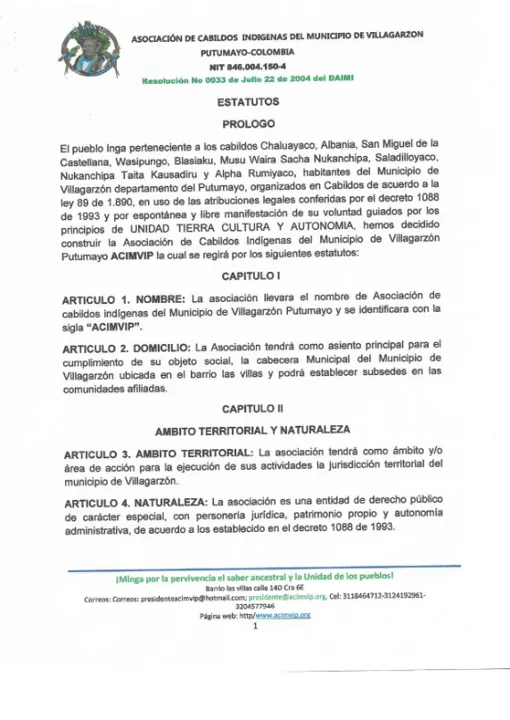 Statutes of ACIMVIP (2016)ACIMVIP
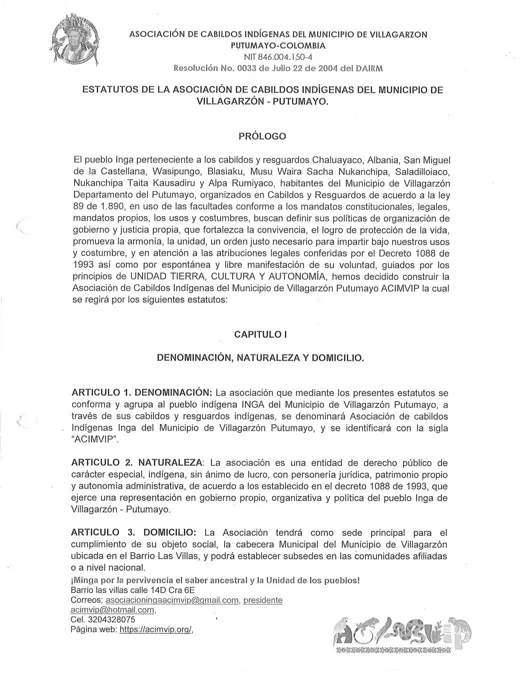 ACIMVIP Bylaws, 2023 amendmentACIMVIP
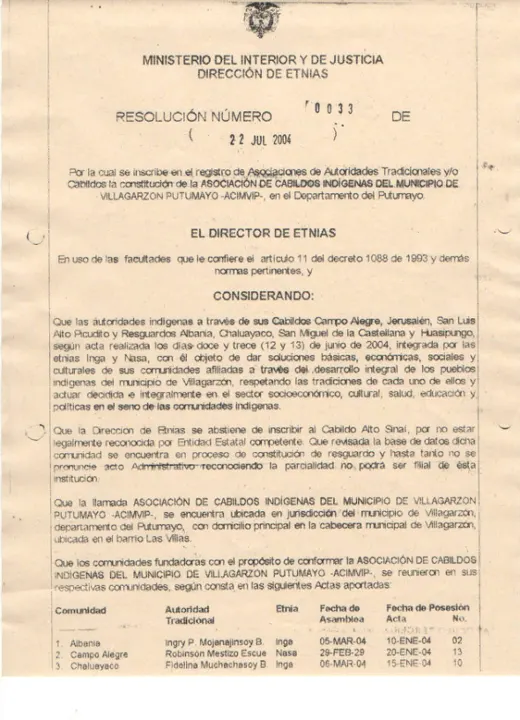 Resolution 0033 of 2004, registration of the establishment of ACIMVIPMinistry of the Interior and of Justice, Directorate of Ethnic Affairs
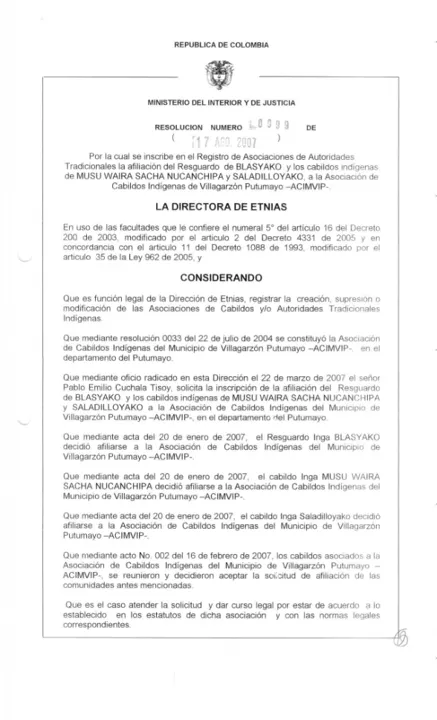 Resolution 0099 of 2007, affiliation of three communities to ACIMVIPMinistry of the Interior and of Justice, Directorate of Ethnic Affairs
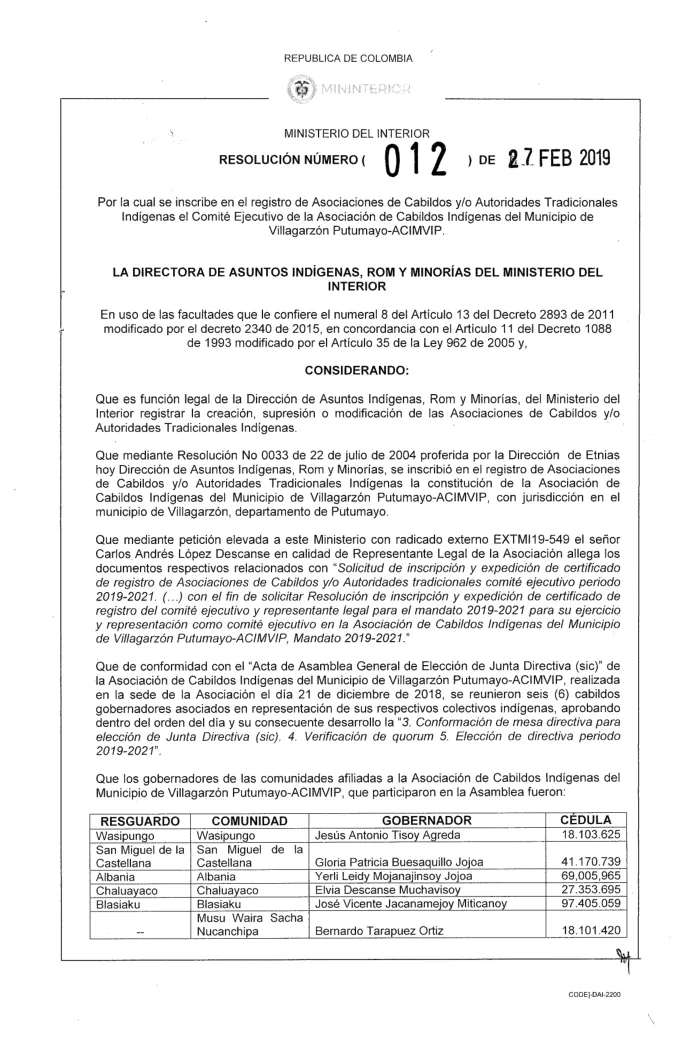 Resolution 012 of 2019, registration of the 2019-2021 Executive CommitteeMinistry of the Interior, Directorate of Indigenous, Rom, and Minority Affairs
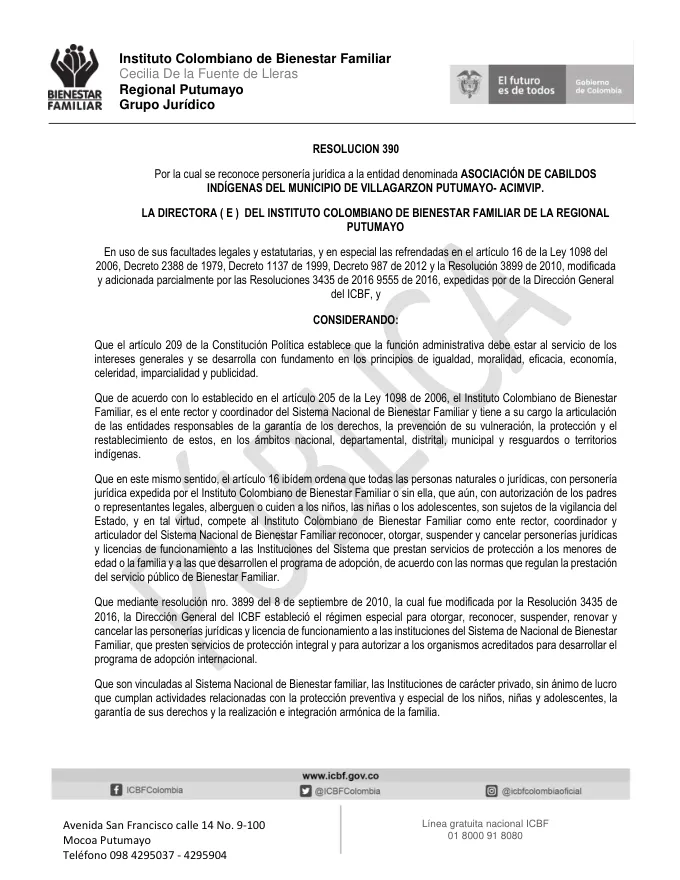 Resolution 390 of 2021, recognition of the legal personality of ACIMVIPICBF, Putumayo Regional Office
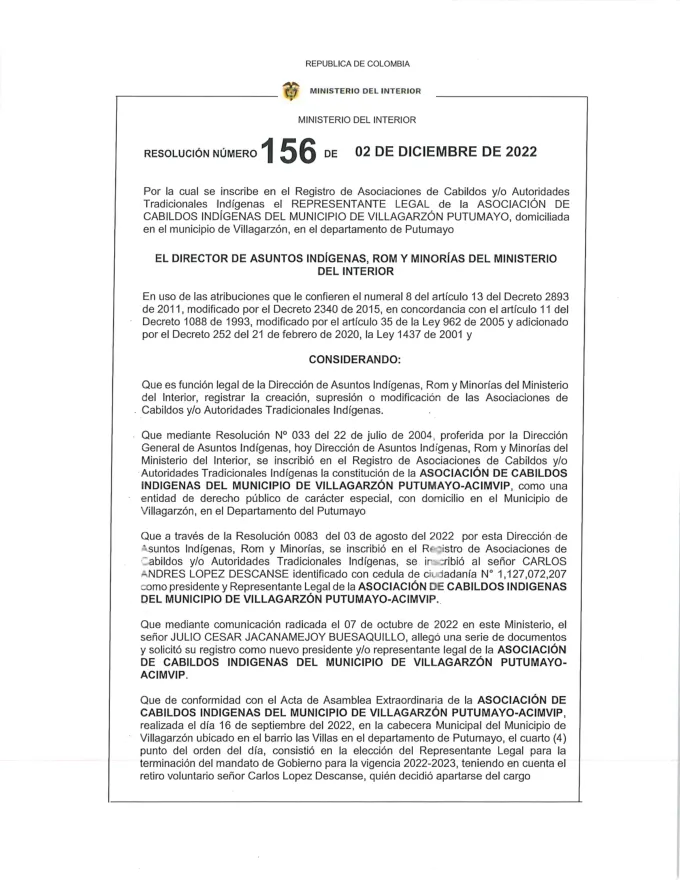 Resolution 156 of 2022, registration of the legal representative (historical)Ministry of the Interior, Directorate of Indigenous, Rom, and Minority Affairs
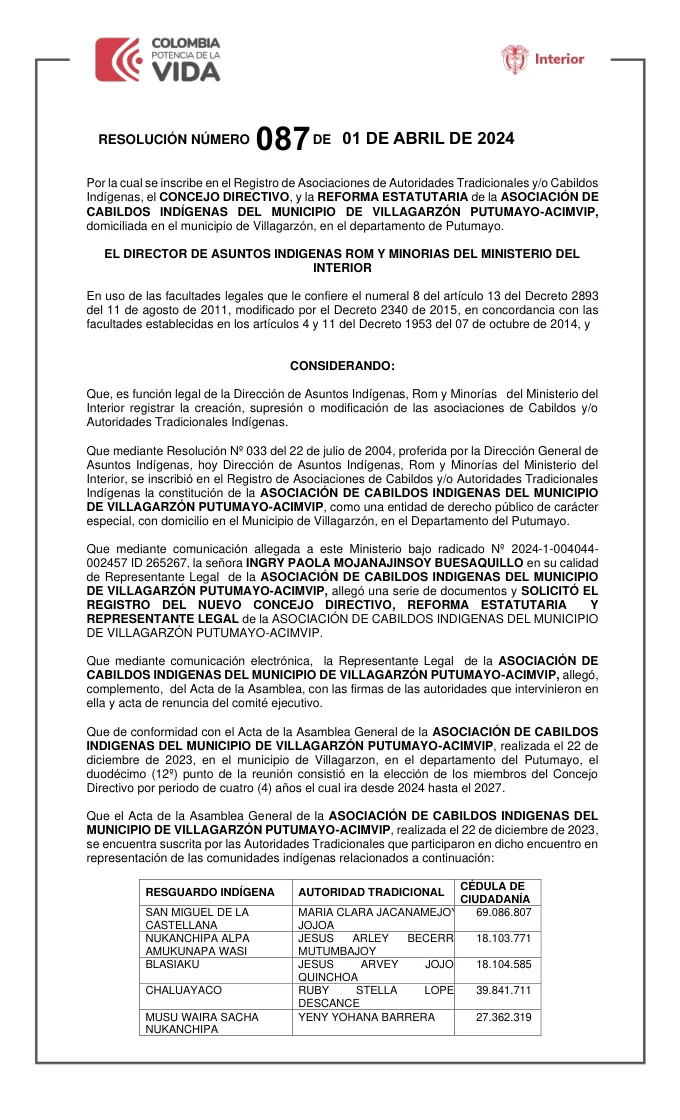 Resolution 087 of 2024, registration of the Board of Directors and of the amendment to the bylawsMinistry of the Interior, Directorate of Indigenous, Rom, and Minority Affairs
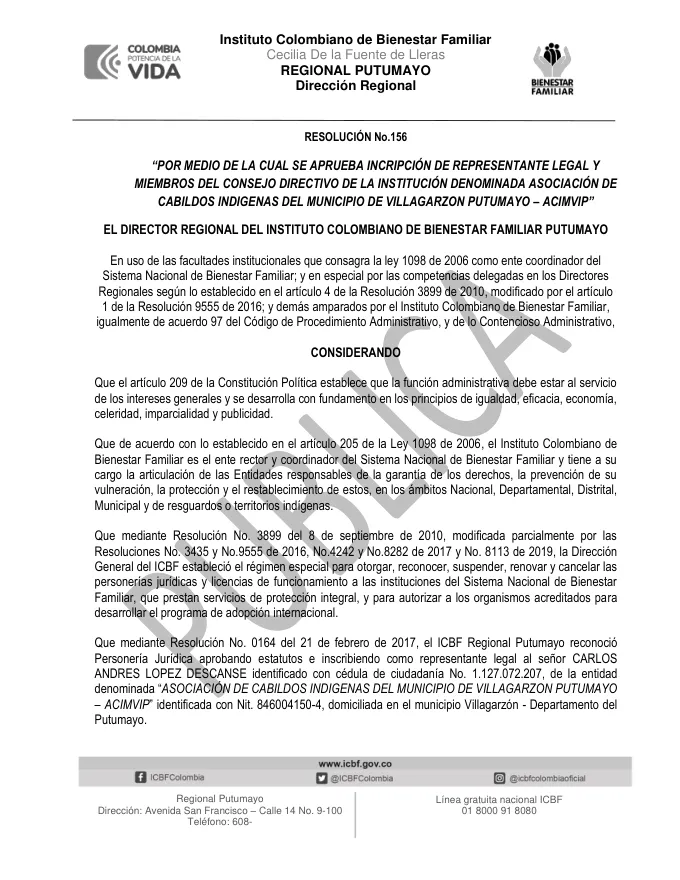 Resolution 156 of 2024, registration of the legal representative and approval of the bylawsICBF, Putumayo Regional Office
 ACIMVIP Strategic Plan 2013-2024ACIMVIP
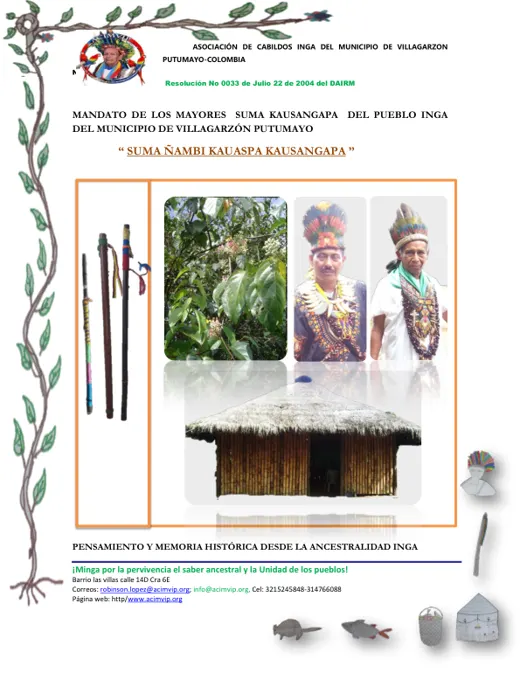 Mandate of the Elders Suma Kausangapa (2015)Authorities of the Inga People of Villagarzón
 Mandate of the Elders Suma Kausangapa, updated versionAuthorities of the Inga People of Villagarzón
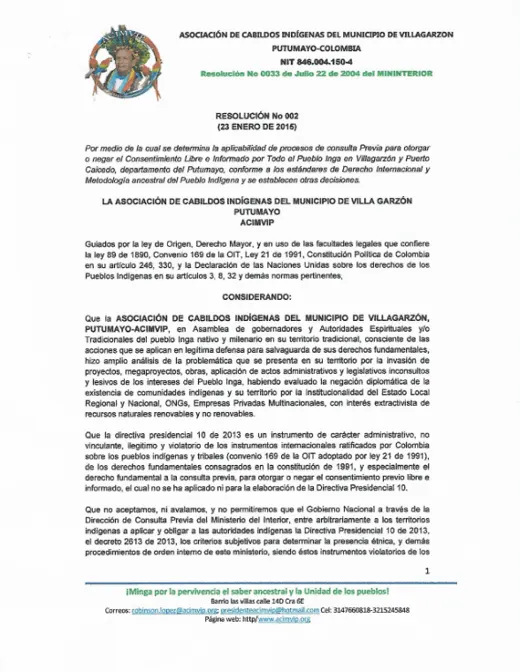 Resolution 002 of 2015, own procedure for consultation and consentACIMVIP
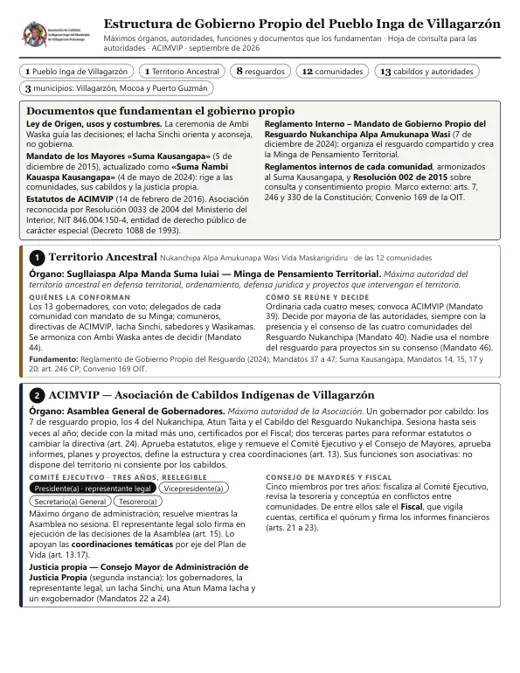 Self-government structure of the Inga People of VillagarzónACIMVIP
About ACIMVIP
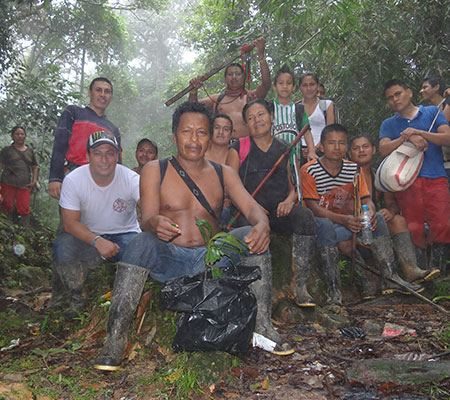
The Association of Indigenous Cabildos of the Municipality of Villagarzón, Putumayo (ACIMVIP) is a non-profit public-law institution of a special Indigenous character, with its own assets and administrative autonomy, which exercises the political representation of the Inga People of Villagarzón, Putumayo, before local, departmental, national and international institutions; its main objective is to ensure that all the collective and individual rights of its members are respected and recognised, supported and valued by all actors in Colombia and by the international community.
Mission
To work for the defence of cultural values, respect for nature, the peaceful coexistence of the Inga People, and cultural, social, economic-productive and political strengthening, within the framework of the Life Plan, forging bonds of friendship with other social sectors and Indigenous organisations of Colombia through dialogue and agreement with municipal, departmental, national and international institutions.
Vision 2030
By 2030, ACIMVIP will be the organisation that legitimately represents the Inga People of the Middle Putumayo before the State and third parties, with a self-government strengthened from the Law of Origin. It will have consolidated the legal and spiritual protection of the Ancestral Territory Nukanchipa Alpa Amukunapa Wasi · Vida Maskarigridiru, recognised as a victim by the Special Jurisdiction for Peace, and will have the Comprehensive Life Plan under way in each Reserve and Cabildo. The Inga language will remain alive in the new generations, the own economy will advance in harmony with nature and ACIMVIP will contribute, together with Amazonian and national Indigenous organisations, to peace and to the rights of the Indigenous Peoples of Colombia.
Vision 2013-2024
With the Strategic Plan 2013-2024 we set ourselves the goal: «The ACIMVIP Organisation, by 2024, will consolidate the unity of the Inga People and a sustainable economic sovereignty, in harmony with nature, that guarantees the survival and the strengthening of the cultural, social and political identity of the Indigenous communities of Villagarzón within the framework of the Life Plan.»
Our principles
- Identity
- Unity
- Belonging
- Respect
- Tolerance
- Solidarity
- Honesty
- Punctuality and timeliness
- Equity and reciprocity
- Equality
- Competence
History
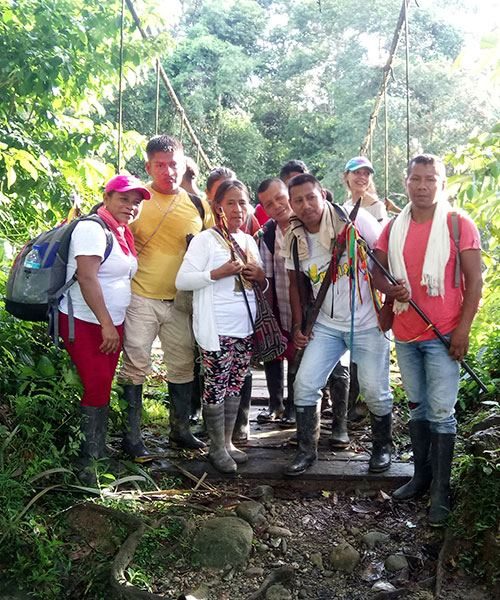
The Association of Indigenous Cabildos of the Municipality of Villagarzón, Putumayo (ACIMVIP) is an initiative of the Inga People, born on 26 March 1998 to work for the defence of collective and individual rights, respect for nature, and the cultural, social, economic, productive and political strengthening of the Indigenous communities of Villagarzón, guided by the principles of UNITY, TERRITORY, CULTURE and AUTONOMY.
ACIMVIP is made up of Inga Reserves and Cabildos of the Municipality of Villagarzón, a population that mostly lives in rural areas and preserves the traditions, uses and customs of the Inga People, such as the Inga mother tongue and the festival of forgiveness and reconciliation held every February, "KARRUSTULINDA" or Atun Puncha. Women devote themselves to crafts and men to cultivating the chagra as a means of subsistence; own education is imparted from the home and strengthened through the teaching of the Atun Ñambi Ethno-educational Institution, which groups seven school sites.
Our path: 1989 – 2026
Dates of foundation, registration, and establishment and expansion of our Reserves, taken from the acts in each record of ACIMVIP's own registers.
- 26 Jun. 1989Establishment of the Inga Indigenous Reserve of Calenturas (INCORA Resolution 045)
- 26 Mar. 1998Foundation of ACIMVIP
- 5 May 1999Establishment of the Inga Indigenous Reserve of Wasipungo (INCORA Resolution 015)
- 9 Dec. 1999Establishment of the Inga Indigenous Reserve of Albania (INCORA Resolution 081)
- 29 Jun. 2000Establishment of the Inga Indigenous Reserve of Chaluayaco (INCORA Resolution 019)
- 10 Dec. 2002Establishment of the Inga Indigenous Reserve of San Miguel de la Castellana (INCORA Resolution 024)
- 22 Jul. 2004Registration with the Ministry of the Interior (Resolution 0033)
- 15 Dec. 2004Establishment of the Inga Indigenous Reserve of Blasiaku (INCODER Agreement 025)
- 30 Jun. 2005Expansion of the Inga Indigenous Reserve of Wasipungo (INCODER Agreement 016)
- Jan. 28, 2020Establishment of the Inga Indigenous Reserve of Nukanchipa Alpa Amukunapa Wasi (ANT Agreement 113), confirmed by Agreement 126
- 2022Report of the Inga People to the Special Jurisdiction for Peace
- 27 May 2025Establishment of the Inga Indigenous Reserve of Saladilloiaco (ANT Agreement 480)
- 8 Oct. 2025Expansion of the Inga Indigenous Reserve of Blasiaku (Agreement 526 of the National Land Agency)
- 2026The JEP recognises the Inga People and their Ancestral Territory as collective subjects who are victims of the conflict
Today ACIMVIP brings together the Reserves of the Inga People: Inga Indigenous Reserve of Albania, Inga Indigenous Reserve of Blasiaku, Inga Indigenous Reserve of Calenturas, Inga Indigenous Reserve of Chaluayaco, Inga Indigenous Reserve of Saladilloiaco, Inga Indigenous Reserve of San Miguel de la Castellana, Inga Indigenous Reserve of Wasipungo and the Inga Indigenous Reserve of Nukanchipa Alpa Amukunapa Wasi. Four Cabildos share the latter: Cabildo Alparumiyaco Alto San Juan Las Delicias, belonging to the Inga Indigenous Reserve of Nukanchipa Alpa Amukunapa Wasi, Cabildo Cachiacu Andaki, belonging to the Inga Indigenous Reserve of Nukanchipa Alpa Amukunapa Wasi, Cabildo Nukanchipa Taita Kausadiru, belonging to the Inga Indigenous Reserve of Nukanchipa Alpa Amukunapa Wasi and Cabildo Musu Waira Sacha Nucanchipa, belonging to the Inga Indigenous Reserve of Nukanchipa Alpa Amukunapa Wasi. It also includes the Cabildo Atun Taita Ambi Upiadiru Indigenous, which does not yet have a constituted Reserve.
Our house: Iuiai Wasi
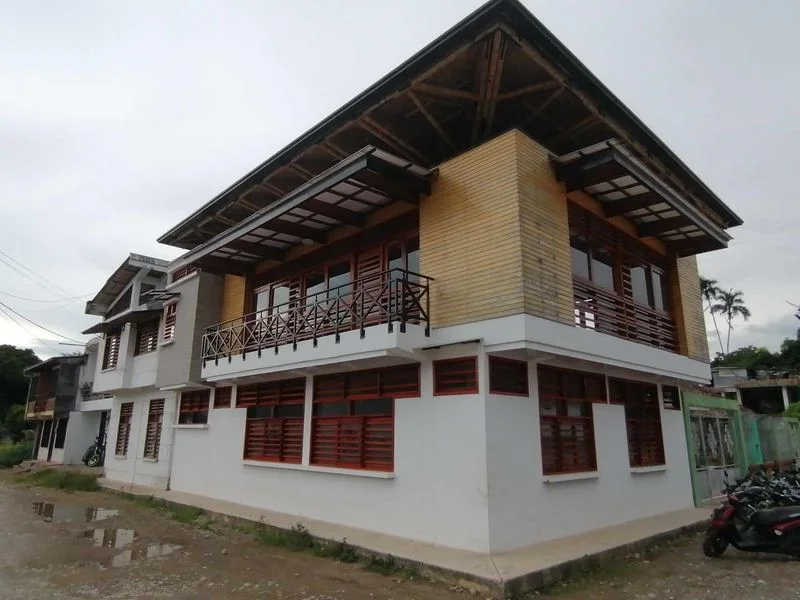
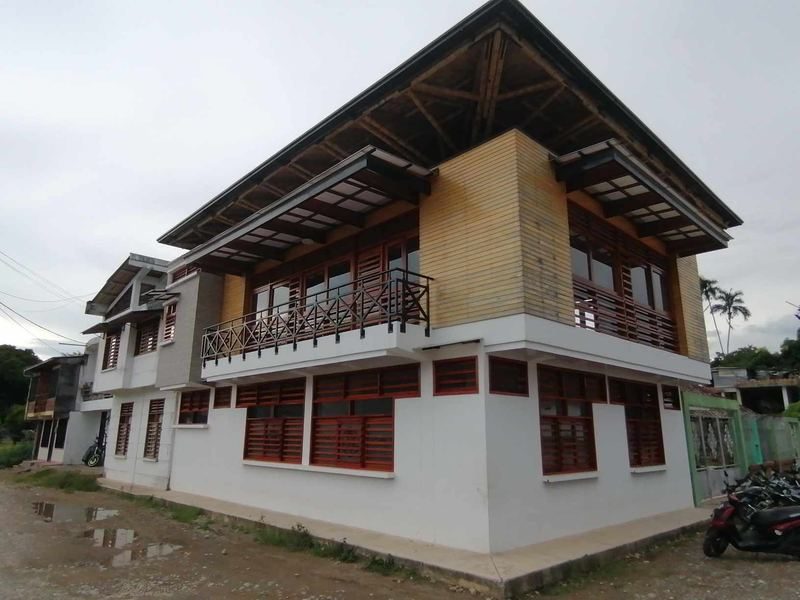
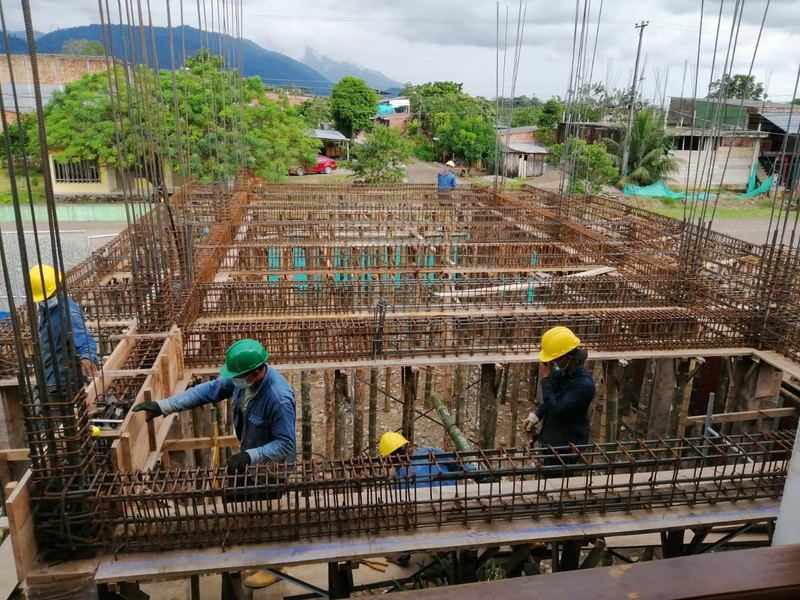
The headquarters of ACIMVIP, Casa de Pensamiento Iuiai Wasi, is located in Barrio Las Villas, Calle 14D with Carrera 6E, Villagarzón, Putumayo. General Secretariat · WhatsApp only: +57 320 432 8075 · Communications · calls and WhatsApp: +57 310 276 6188 (WhatsApp) · asociacioningaacimvip@gmail.com · view on Google Maps.