News · 31 May 2016
Community Educational Project of the Atun Ñambi Inga Bilingual Rural Ethno-educational Institution
The Inga Atun Ñambi Rural Bilingual Ethno-educational Institution is a public Indigenous institution located in the Inga Indigenous Reservation of San Miguel de la Castellana, 26 kilometres from the municipal seat of Villagarzón (Putumayo) and 16 kilometres from the township of Puerto Umbría. It has ten campuses in villages of the San Miguel de la Castellana, Blasiaku, Playa Larga, Wasipungo and Alpa Rumiiaku reservations; it offers pre-school, primary, lower secondary and vocational upper secondary education at the main campus, and pre-school and primary education at the other campuses, with bilingual education based on interculturality. It serves Inga, Awá, Afro-descendant and peasant students.
Its Community Educational Project (PEC) was approved by Resolution 2046 of 31 May 2016; the document presented here, of 184 pages, is the 2024 version. The institution has been officially recognized since Resolution 2084 of 6 May 2013, and Resolution 4946 of 16 November 2017 authorized the operation of the eleventh grade. The educational proposal is guided by the guidelines of the Inga People's own education model, prepared in 2012 by the Inga of Caquetá, Nariño, Cauca and Putumayo, so that the Inga language, medicine and spirituality are lived at school and the ancestral legacy of the Inga People and the Awá People does not disappear.
The PEC is structured in five components: general aspects (objectives, aims, principles and institutional symbols); reference frameworks (regulatory, historical, contextual and conceptual); the pedagogical component, with the educational spaces —territory, home, community and school—, the learning cycles, the community's own calendar, the weaving of knowledge and the curriculum; the political-organizational component, with the community's own laws, the senior Cabildo (Indigenous traditional authority), the student cabildo and the education committee; and the administrative component, with the school population, resources, and the procedures and coexistence manuals. The full PDF can be read below this note.
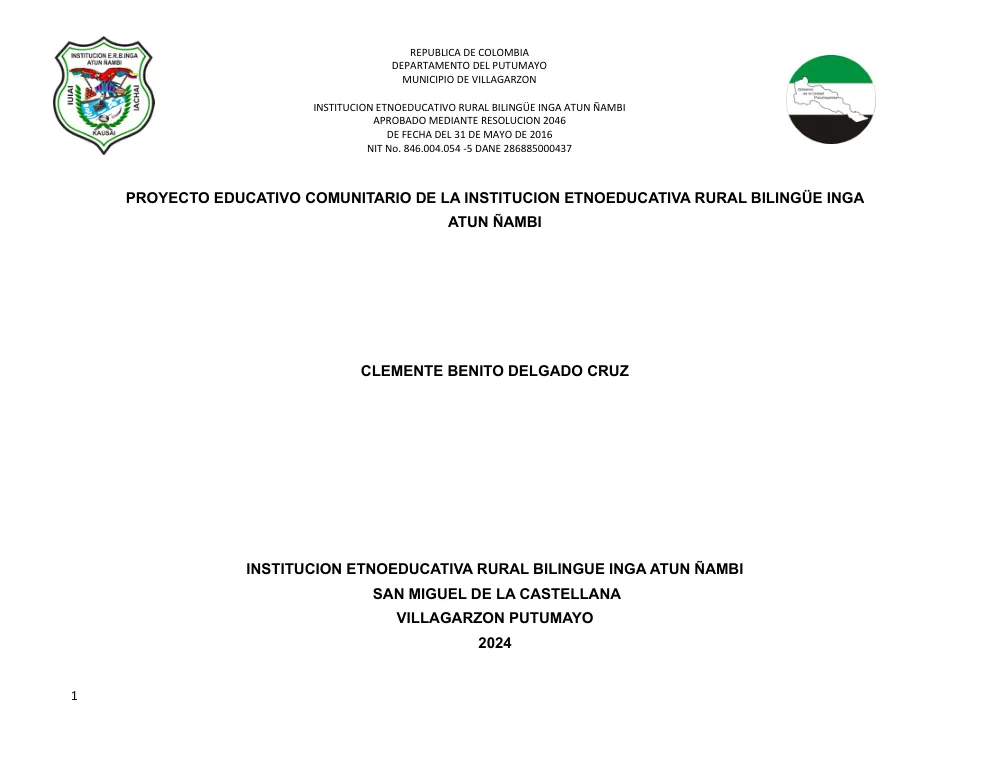 Publication document (PDF)Tap the cover to read it in full.
More news
Publication document (PDF)Tap the cover to read it in full.
More news